
Mimic Raises $16 Million Seed Round to Build the AI Simulation Engine That Lets Companies Test Reality Before They Act
November 8, 2025
by
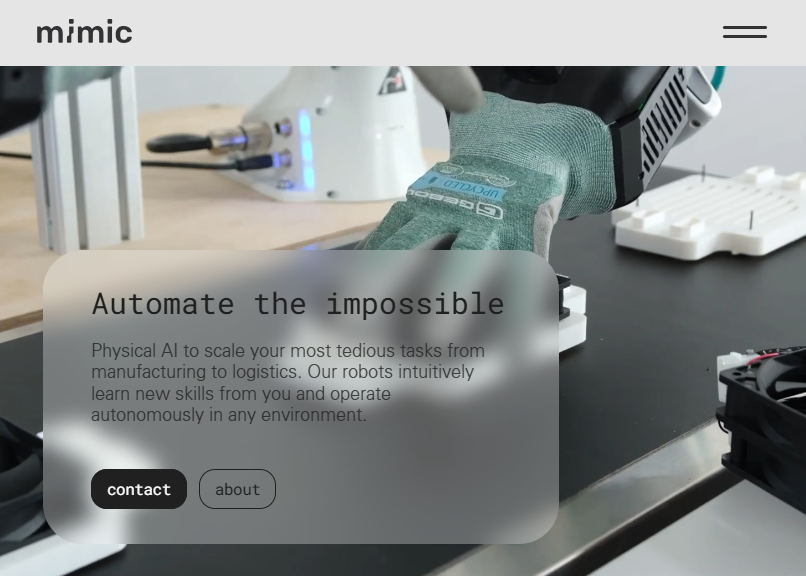
mimic (Switzerland) has raised $16,000,000 in their Seed Round, backed by Elaia, Speedinvest, Founderful, 1st Kind, 10x Founders, 2100 Ventures, and the Sequoia Scout Fund. Led by Stefan Weirich, mimic is not building “AI automation.” It’s building something far more powerful: a simulation engine that predicts real-world outcomes before decisions are made. Companies feed mimic their systems, processes, product logic, and operational constraints, and mimic creates a digital clone of the business - a high-fidelity environment where teams can test decisions without risking time, money, or reputation. In a world where guessing is expensive, mimic gives organizations the ability to rehearse success.
Reframing AI: Not “Automate Execution” - but “Simulate and Validate Before You Execute”
Traditional AI tools generate output - emails, content, automations, dashboards. mimic generates certainty. Instead of launching a new product feature and hoping users adopt it, mimic lets companies simulate that behavior across realistic scenarios. Teams can model user behavior, stakeholder interactions, and operational outcomes. They can test pricing, onboarding flows, or entire customer journeys before writing a single line of code. mimic absorbs internal business logic and external signals to forecast how decisions will play out. The shift is massive: companies stop asking, “What should we do?” and start asking, “Which version of success should we choose?”
In a market where speed has been worshipped, mimic builds a world where precision wins instead of chaos.
mimic Isn’t a Tool - It’s the Intelligence System Under Every Decision
Every major company struggles with the same paralysis: decisions take too long, involve too many stakeholders, and require too much data. mimic eliminates the friction entirely. The platform becomes the cognitive environment where strategies are tested and validated automatically. Instead of pulling data from dashboards, mimic simulates outcomes, highlights risks, and recommends paths. And because it integrates with internal systems, it mirrors a company’s unique reality - not generic templates.
Where most platforms track what already happened, mimic predicts what will happen next.
Companies don’t need more analytics. They need foresight.
The Fastest Way to Win Is Avoiding the Decisions That Fail
Here’s the move that separates category leaders from everyone else:
you don’t scale by doing more - you scale by eliminating mistakes.
mimic’s core advantage is removing the cost of bad decisions:
- Wrong pricing strategy? Simulate it.
- What if onboarding flow changes? Simulate it.
- New product feature? Simulate user behavior before launch.
- Shift in sales process? Simulate revenue impact.
Companies burn millions validating decisions in the real world. mimic shifts validation into a risk-free simulation.
The real leverage isn’t faster execution.
It’s fewer wasted cycles.
The Hidden Value: Most Companies Don’t Have a Decision Problem - They Have a Visibility Problem
Execution isn’t the issue.
Organizations work hard - they just work hard on the wrong things.
mimic solves the real bottleneck:
- Too many competing opinions
- Too much risk aversion
- Too many variables to evaluate manually
When decision friction disappears, execution flows.
When clarity exists, confidence follows.
mimic doesn’t help teams think more.
It helps them think better - together.
Investor Alignment: Elaia, Speedinvest, and Sequoia Aren’t Betting on a Platform - They’re Betting on the “Digital Twin Economy”
Look at mimic’s cap table and you see a thesis:
- Elaia → Deep tech category creation
- Speedinvest → Early-stage B2B SaaS market winners
- Sequoia Scout Fund → Early bets on paradigm shifts
Their investment signals something:
The next enterprise frontier isn’t automation or analytics - it’s simulation.
Simulation is already transforming industries:
- Tesla trains autonomous driving in simulation environments.
- Airlines train pilots in flight simulators.
- Pharma tests drug behavior using simulated modeling.
mimic brings that superpower to every operational and strategic business decision.
A Market Primed for Mimic: Strategy Testing Is Becoming a Billion-Dollar Category
The data paints the picture:
- Gartner predicts 70% of enterprise organizations will use digital twins by 2027.
- The business simulation market is projected to reach $63.5 billion by 2032, driven by AI and real-time modeling.
- McKinsey reports that poor decision-making costs organizations 3–5% of revenue annually.
- Bain identifies that fast, informed decisions are the #1 factor in outperforming competition.
The trend line is clear:
Companies that simulate will outperform companies that execute blindly.
The winners of the next decade will be the companies that practice before they perform.
Why mimic Wins: Because Insight Beats Speed
We’ve spent years idolizing speed - ship fast, break things, iterate later.
But speed without direction is expensive.
mimic is the antidote.
By the time your competitors:
- debate in meetings,
- gather data,
- run committees,
- and build slides…
mimic users already know which strategy wins.
Not because they guessed -
because they tested multiple realities before choosing one.
What’s Next for Mimic
With $16M raised, mimic is scaling toward:
- deeper enterprise integrations,
- higher-fidelity simulations of business processes,
- simulation libraries for common organizational decisions,
- enterprise onboarding for complex workflows.
The long-term vision:
become the simulation environment for every high-impact decision inside a company.
Companies used to operate on experience.
Now they’ll operate on simulation.
Final Thoughts
Most startups focus on execution.
mimic focuses on certainty.
Most enterprise platforms track work.
mimic shapes the future before work begins.
The world is moving from:
- react → predict
- optimize → simulate
- guess → know
mimic isn’t building a productivity app.
It’s building a strategy engine.
Companies no longer need to hope decisions work.
They can prove it - before they commit.
Related Articles

Latest Rounds
November 30, 2025 by
EcoG Raises $18.57M to Accelerate the Operating System for the Global EV Charging Economy
EcoG has raised $18,573,280 in new funding, led by GET Fund with participation from Extantia Capital and Bayern Kapital. Founded...
Read More
Latest Rounds
November 30, 2025 by
Tidalwave Raises $22M Series A to Build the Infrastructure Layer Modern Homebuilders Need for AI-Driven Operations
Tidalwave has raised $22,000,000 in their Series A, led by Permanent Capital with participation from D.R. Horton, Inc. and Engineering...
Read More
Latest Rounds
November 30, 2025 by 
WellBeam Raises $10M to Unify Care Coordination Across the Entire Patient Journey
WellBeam Inc. has secured $10 million in Series A funding, marking a major step toward fixing one of the most...
Read More
Latest Rounds
November 30, 2025 by
Automat Raises $15.5M to Redefine Industrial Automation With Adaptive AI
Automat has secured $15.5 million in Series A funding, a major milestone for a company working to radically transform how...
Read More
Latest Rounds
November 30, 2025 by
Poly Raises $8M to Reinvent How People Organize, Search, and Think With Their Files
Poly (US) has closed an $8,000,000 Seed round, marking a decisive moment for one of the most ambitious productivity startups...
Read More
Latest Rounds
November 30, 2025 by
Voio Raises $8.6M to Power AI That Understands Patients as Individuals, Not Data Points
Voio has secured $8.6 million in Seed funding, marking a major step forward for a company working to bring true...
Read More
Latest Rounds
November 30, 2025 by
Ember Raises $4.3M to Reinvent AI-Driven Revenue Cycle Management for Healthcare Providers
Ember has secured $4.3 million in Seed funding, marking a major step toward transforming one of healthcare’s most expensive, error-prone,...
Read More
Latest Rounds
November 30, 2025 by
Modern Life Raises $20M to Redefine Life Insurance Infrastructure With AI-Powered Tools for Advisors
Modern Life has secured $20 million in new funding, marking another major milestone in its mission to rebuild the fractured,...
Read More
Latest Rounds
November 30, 2025 by
Ampersand Raises $80M to Power the Next Era of High-Performance Materials
Ampersand has secured a major $80 million Series A round, positioning itself as one of the most significant deep-tech companies...
Read More
Latest Rounds
November 30, 2025 by
OpenHands Raises $18.8M to Bring Autonomous Coding Agents Into the Enterprise
OpenHands has raised $18.8 million in Series A funding, marking one of the strongest signals yet that autonomous software development...
Read More