
Fintary Raises $10M to Supercharge Agent Payouts and Revenue Growth for Brokerages
November 23, 2025
by
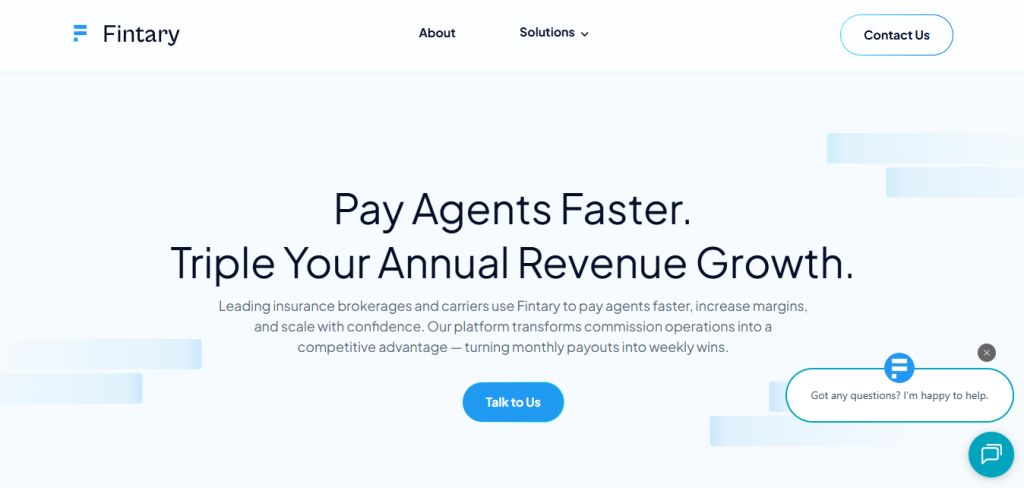
Fintary has raised $10,000,000 in Series A funding to overhaul how brokerages pay agents, track commissions, and grow recurring revenue. The round includes backing from Infinity Ventures, SIERRA Ventures, and existing investors, fueling the company’s mission to modernize the financial infrastructure behind broker compensation.
Founded by Qiyun Cai, Yu Chen, and Michael Lee, Fintary offers a platform that simplifies commission workflows for brokerages and financial advisory firms - where complex payout rules, fragmented systems, and manual spreadsheets have long slowed down revenue operations. By automating payouts and analytics, Fintary helps firms move faster, reduce errors, and more importantly, keep top-producing agents loyal by paying them accurately and on time.
Why Agent Payouts Needed an Overhaul
Brokerage organizations - whether in insurance, finance, or real estate - operate in industries where compensation is performance-driven and data-heavy. Yet most rely on outdated tools that make growth harder.
Agent commissions often involve layered rates, overrides, bonuses, renewals, and compliance-specific adjustments. When calculated manually, even a minor discrepancy can ripple into disputes, mistrust, and delayed revenue recognition. Studies show that over 55% of brokerages still rely on spreadsheets for commission processing, and manual payout errors account for up to 20% of agent churn in competitive markets.
Meanwhile, firms that move to real-time commission systems see revenue cycle acceleration of 25–40%, largely because faster payouts translate to more aggressive sales activity and fewer administrative bottlenecks.
Fintary isn’t just digitizing commissions - it’s treating payouts as a growth engine.
The Value Shift: Owning the Financial Operating Layer
The most successful fintech platforms don’t elevate productivity - they embed themselves at the financial core of an organization's operations. Once payouts, revenue tracking, reporting, and compliance live inside a single platform, the cost of switching becomes exponentially higher. Data flows through the system. Teams make decisions through it. Revenue is recognized through it.
When a platform becomes the default source of financial truth, the business relies on it to function - not the other way around.
This is where Fintary gains strategic leverage. Instead of being a tool that agents log into occasionally, it becomes the infrastructure that determines how money moves inside the organization. Companies that own this layer don’t just support workflows - they define them, shaping how revenue is tracked, earned, and distributed.
In industries where top talent migrates to firms that pay faster and more transparently, controlling the payout infrastructure becomes an advantage that compounds.
A Growing Market for Financial Automation in Brokerage
The market demand backing this shift is large and accelerating. Globally, the brokerage and advisory software market is expanding as firms move from manual back-office operations toward automated financial systems.
Key trends driving adoption:
- The brokerage tech market is projected to grow at ~14% CAGR through 2030.
- More than 70% of financial services organizations plan to automate payouts and commission workflows in the next five years.
- Agent-led industries are losing an estimated $1.5B annually to payout disputes, misallocated commissions, and delayed reconciliation.
At the same time, advisory firms are shifting from one-time sales to recurring revenue offerings - meaning payouts are no longer single transactions but long-term revenue streams that require precise tracking over time. Fintary is designed specifically for this shift.
If legacy broker systems were built for transaction-based payouts, platforms like Fintary are being built for subscription-era compensation.
Why Fintary Is Positioned to Scale
Fintary’s platform brings together commission rules, analytics, cross-agency reporting, and automated reconciliation into one system. By doing so, it aligns executive priorities (profit visibility), agent needs (fast accurate payouts), and operational requirements (compliance and reporting).
This matters because firms scaling past a certain threshold no longer struggle with winning business - they struggle with accurately managing the business they already have. As competition intensifies and agent recruitment becomes a race, software that keeps top performers paid on time becomes a differentiator, not an administrative perk.
The platform's architecture also implies natural expansion into adjacent financial systems, including:
- CRM and revenue attribution data
- Renewal tracking and long-term commission forecasting
- Accounting platform integrations
- Financial compliance reporting
The more financial logic Fintary absorbs, the more indispensable it becomes.
What Comes Next
With $10M in new capital, Fintary plans to accelerate:
- Expansion across large brokerage and enterprise accounts
- More advanced revenue intelligence and forecasting tools
- Deeper integrations with financial systems and CRM platforms
- Hiring across engineering and go-to-market teams
The broader vision goes beyond payout automation: Fintary is positioning itself as the financial operating system for broker-led businesses.
When money moves faster, organizations grow faster - and Fintary is building the rails that make that possible.
Related Articles

Latest Rounds
November 30, 2025 by 
EcoG Raises $18.57M to Accelerate the Operating System for the Global EV Charging Economy
EcoG has raised $18,573,280 in new funding, led by GET Fund with participation from Extantia Capital and Bayern Kapital. Founded...
Read More
Latest Rounds
November 30, 2025 by
Tidalwave Raises $22M Series A to Build the Infrastructure Layer Modern Homebuilders Need for AI-Driven Operations
Tidalwave has raised $22,000,000 in their Series A, led by Permanent Capital with participation from D.R. Horton, Inc. and Engineering...
Read More
Latest Rounds
November 30, 2025 by
WellBeam Raises $10M to Unify Care Coordination Across the Entire Patient Journey
WellBeam Inc. has secured $10 million in Series A funding, marking a major step toward fixing one of the most...
Read More
Latest Rounds
November 30, 2025 by
Automat Raises $15.5M to Redefine Industrial Automation With Adaptive AI
Automat has secured $15.5 million in Series A funding, a major milestone for a company working to radically transform how...
Read More
Latest Rounds
November 30, 2025 by
Poly Raises $8M to Reinvent How People Organize, Search, and Think With Their Files
Poly (US) has closed an $8,000,000 Seed round, marking a decisive moment for one of the most ambitious productivity startups...
Read More
Latest Rounds
November 30, 2025 by
Voio Raises $8.6M to Power AI That Understands Patients as Individuals, Not Data Points
Voio has secured $8.6 million in Seed funding, marking a major step forward for a company working to bring true...
Read More
Latest Rounds
November 30, 2025 by
Ember Raises $4.3M to Reinvent AI-Driven Revenue Cycle Management for Healthcare Providers
Ember has secured $4.3 million in Seed funding, marking a major step toward transforming one of healthcare’s most expensive, error-prone,...
Read More
Latest Rounds
November 30, 2025 by
Modern Life Raises $20M to Redefine Life Insurance Infrastructure With AI-Powered Tools for Advisors
Modern Life has secured $20 million in new funding, marking another major milestone in its mission to rebuild the fractured,...
Read More
Latest Rounds
November 30, 2025 by
Ampersand Raises $80M to Power the Next Era of High-Performance Materials
Ampersand has secured a major $80 million Series A round, positioning itself as one of the most significant deep-tech companies...
Read More
Latest Rounds
November 30, 2025 by
OpenHands Raises $18.8M to Bring Autonomous Coding Agents Into the Enterprise
OpenHands has raised $18.8 million in Series A funding, marking one of the strongest signals yet that autonomous software development...
Read More