
Inception Raises $50 Million to Build High-Speed Diffusion LLMs for Enterprise Deployment
November 23, 2025
by
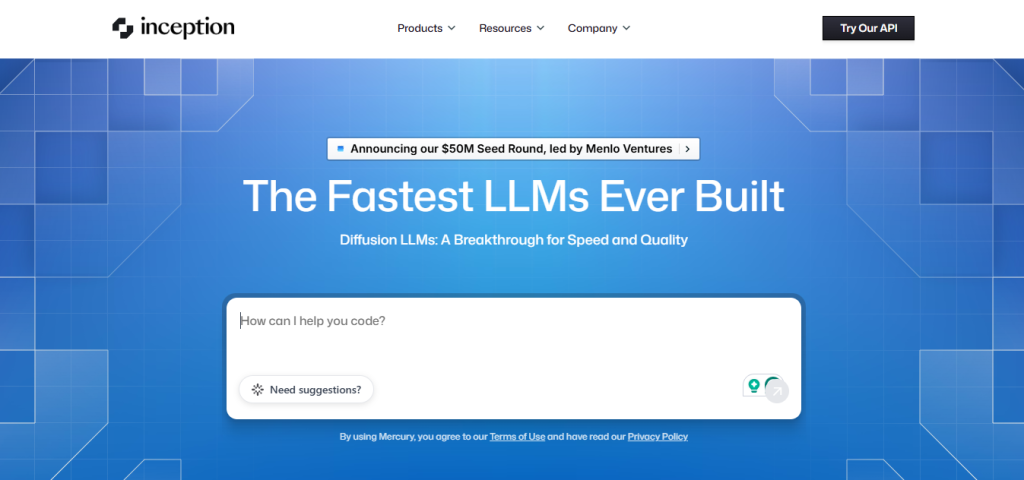
Inception has raised $50,000,000 to scale its diffusion-based large language models, designed to deliver faster inference, lower latency, and cost-efficient deployment for enterprise AI. The round was led by Menlo Ventures, with participation from Mayfield, Innovation Endeavors, NVentures (NVIDIA’s venture arm), M12 (Microsoft’s Venture Fund), Snowflake Ventures GmbH, and Databricks Investment, under the leadership of Stefano Ermon.
Instead of competing on model size or academic benchmarks, Inception is targeting the performance layer - how intelligence is executed at scale in real-world systems. Its models are optimized for throughput rather than novelty, aiming to make AI economically viable for products that run continuous inference, multi-agent architectures, and real-time decision loops.
The Market Is Shifting Toward Efficient AI Deployment
AI development has accelerated faster than infrastructure can support. The compute required to train state-of-the-art models has increased exponentially over the past five years, while enterprises struggle to deploy models economically. Global AI infrastructure spending is projected to surpass $400 billion by 2030, driven largely by inference, which is expected to account for the majority of AI-related cloud costs.
Real-time model execution is becoming the dominant use case. Financial institutions are integrating AI into live trading signals and fraud prevention. Autonomous systems in logistics and defense rely on sub-second reasoning. Enterprise software providers are building always-on copilots embedded directly into workflow systems. Research estimates that real-time workloads will grow significantly faster than batch workloads, with adoption forecast to multiply several times over in the next decade.
The problem is not accuracy - it is viability. Surveys show that more than 90% of enterprises evaluating AI cite inference cost as a limiting factor, and many pilot deployments fail not due to poor models but due to infrastructure overhead. As adoption scales, cost-to-performance ratio becomes the determining factor in whether AI reaches consumer-grade ubiquity or remains limited to high-value verticals.
What Inception Offers
Inception is building diffusion-based language models that rely on different computational pathways than transformer-based LLMs. This architecture allows parallelizable inference, reduced token-by-token overhead, faster generation, and lower memory footprints. The result is faster responses under heavy load and more predictable performance when models are executed across thousands of concurrent calls.
These optimizations are designed for environments where models are not accessed sporadically but run continuously as part of mission-critical systems. That includes autonomous agents, streaming analytics, conversational platforms with large user bases, and backend AI engines that replace scripted logic.
The Strategic Advantage: Controlling Execution, Not Just Intelligence
Many AI companies focus on model capabilities, but as high-performance open models become widely available, the race shifts to how efficiently those models can be deployed. Inference cost compounds. A slight reduction in latency or energy usage scales into major financial advantages when running millions of tokens per hour.
When an enterprise builds its infrastructure, routing logic, and agent workflows around a specific performance profile, switching becomes difficult. The stickiness comes not from proprietary weights but from integration into the execution environment. This reflects the same pattern seen in cloud computing, where orchestration and reliability mattered more than raw compute supply.
If AI becomes a pervasive computing layer, the bottleneck will be throughput, not model count. Inception is building for that horizon.
Why the Timing Matters
Several global forces align with Inception’s strategy. Enterprises are moving beyond experimentation and into full-scale deployment. National AI policies and regulatory frameworks increasingly require traceable and efficient compute usage. Cloud spending is under scrutiny as companies seek to justify total cost of ownership rather than experimentation budgets.
Meanwhile, industries such as finance, defense, gaming, biotech, logistics, and insurance are transitioning toward AI systems that run continuously. These sectors collectively represent a significant share of future inference demand and require models that operate reliably in production, not just during benchmarks. Forecasts indicate that such real-time workloads may represent the majority of enterprise inference volumes within the next decade.
In this environment, performance becomes a competitive moat. Faster AI enables smaller hardware footprints, which enable more geographic deployment, which enables lower delivery cost and new categories of products. Efficiency is not just a technical win - it is a market accelerator.
What’s Next for Inception
With $50 million in funding, Inception plans to expand access to its models globally, refine hardware-optimized runtimes, and support developers building multi-agent and continuous inference systems. The company also intends to deepen alignment with cloud ecosystems and data platforms to make deployment seamless across enterprise pipelines. Rather than positioning itself as a standalone alternative to major labs, Inception aims to function as an execution layer, powering AI across diverse application surfaces.
Why It Matters
The next phase of AI adoption will be defined not by who trains the largest models, but by who enables intelligence to run persistently, affordably, and at planetary scale. As AI shifts from novel feature to foundational computing layer, the winners will be those who treat inference efficiency as a first principle, not a later optimization.
Inception is not positioning itself as a research lab - it is positioning itself as infrastructure. If it succeeds, it may redefine the economics of running intelligence in production, unlocking product categories that are currently too slow or too costly to exist.
Related Articles

Latest Rounds
November 30, 2025 by 
EcoG Raises $18.57M to Accelerate the Operating System for the Global EV Charging Economy
EcoG has raised $18,573,280 in new funding, led by GET Fund with participation from Extantia Capital and Bayern Kapital. Founded...
Read More
Latest Rounds
November 30, 2025 by
Tidalwave Raises $22M Series A to Build the Infrastructure Layer Modern Homebuilders Need for AI-Driven Operations
Tidalwave has raised $22,000,000 in their Series A, led by Permanent Capital with participation from D.R. Horton, Inc. and Engineering...
Read More
Latest Rounds
November 30, 2025 by
WellBeam Raises $10M to Unify Care Coordination Across the Entire Patient Journey
WellBeam Inc. has secured $10 million in Series A funding, marking a major step toward fixing one of the most...
Read More
Latest Rounds
November 30, 2025 by
Automat Raises $15.5M to Redefine Industrial Automation With Adaptive AI
Automat has secured $15.5 million in Series A funding, a major milestone for a company working to radically transform how...
Read More
Latest Rounds
November 30, 2025 by
Poly Raises $8M to Reinvent How People Organize, Search, and Think With Their Files
Poly (US) has closed an $8,000,000 Seed round, marking a decisive moment for one of the most ambitious productivity startups...
Read More
Latest Rounds
November 30, 2025 by
Voio Raises $8.6M to Power AI That Understands Patients as Individuals, Not Data Points
Voio has secured $8.6 million in Seed funding, marking a major step forward for a company working to bring true...
Read More
Latest Rounds
November 30, 2025 by
Ember Raises $4.3M to Reinvent AI-Driven Revenue Cycle Management for Healthcare Providers
Ember has secured $4.3 million in Seed funding, marking a major step toward transforming one of healthcare’s most expensive, error-prone,...
Read More
Latest Rounds
November 30, 2025 by
Modern Life Raises $20M to Redefine Life Insurance Infrastructure With AI-Powered Tools for Advisors
Modern Life has secured $20 million in new funding, marking another major milestone in its mission to rebuild the fractured,...
Read More
Latest Rounds
November 30, 2025 by
Ampersand Raises $80M to Power the Next Era of High-Performance Materials
Ampersand has secured a major $80 million Series A round, positioning itself as one of the most significant deep-tech companies...
Read More
Latest Rounds
November 30, 2025 by
OpenHands Raises $18.8M to Bring Autonomous Coding Agents Into the Enterprise
OpenHands has raised $18.8 million in Series A funding, marking one of the strongest signals yet that autonomous software development...
Read More