
Graymatter Labs Raises $1.3M to Build AI-Driven Brain Health Diagnostics and Cognitive Performance Tools
November 28, 2025
by
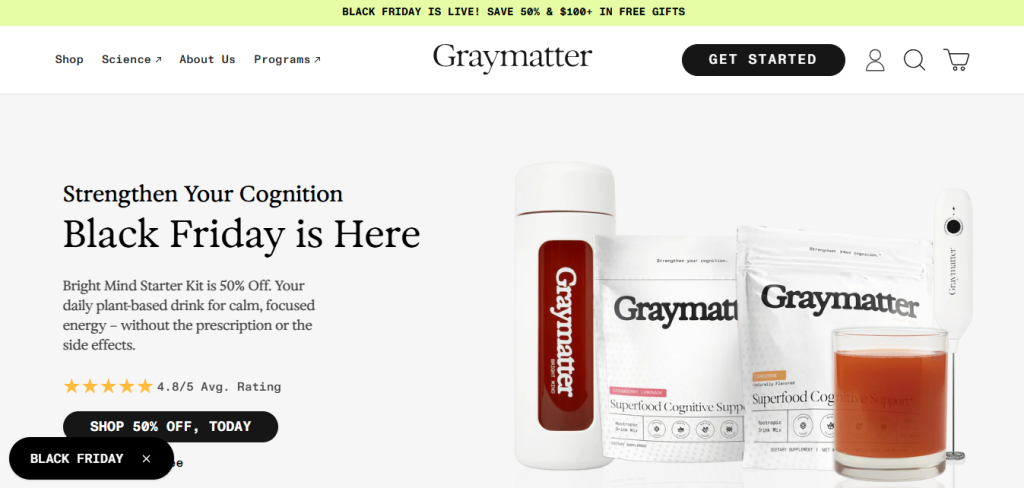
Graymatter Labs has raised $1,300,000 in Seed funding to accelerate the development of its AI-based platform for brain health diagnostics and cognitive performance analysis. The round includes participation from Venrex and APEX, supporting founder Jim Phillips as the company pushes toward scalable neurological assessment tools designed for clinical, athletic, and wellness environments.
Unlike traditional neurotech solutions that rely on static tests or hardware-heavy monitoring, Graymatter Labs focuses on adaptive assessments powered by machine learning. Their platform aims to provide early detection insights, cognitive benchmarking, and personalized improvement pathwaysbringing neurological analysis out of specialized research labs and into everyday use cases.
The Market Need: Brain Health Is Becoming a Mainstream Priority
Cognitive decline, neurological disorders, and concussion-related injuries are rising in both medical and non-medical settings. Yet most assessments require clinical-grade environments, long wait times, and fragmented data collection. Graymatter Labs addresses key gaps: faster screening, continuous monitoring, and scalable data interpretation.
Industry trends underscore the demand:
- Over 55 million people worldwide currently live with dementia, projected to rise nearly 70% by 2050
- The global brain health market is expected to exceed $15 billion by 2030, growing at roughly 12% CAGR
- Sports-related brain injuries are estimated to affect 3 million U.S. athletes annually
- More than 1 in 3 adults report cognitive performance concerns even without clinical diagnoses
The market is shifting from reactive treatment to proactive neurological wellness.
How Graymatter Labs Differentiates
Instead of positioning itself strictly as medical diagnostics or consumer wellness, Graymatter Labs sits between bothtargeting:
- Early-stage cognitive decline detection
- Performance tracking for athletes and high-intensity professionals
- Cognitive analytics for mental health providers
- At-home neurological screening
Its platform pairs digital assessments with machine learning models that interpret behavioral, motor, and cognitive signals beyond simple scoring. This allows for more continuous monitoring, not single-point evaluations.
Why Their Model Has Leverage
Neurological data compounds in value the longer it is tracked. When platforms capture repeated assessments over months or years, they gain predictive powerdetecting deviation from personal baseline rather than generic population curves.
This matters because cognitive decline often presents subtly long before major symptoms appear. Systems that observe a user's long-term patterns have a structural advantage over tools that only test once.
Platforms that own multi-year neurological baselines become embedded in patient journeys, athletic programs, or clinical workflows. Over time, switching costs increase because historical data becomes part of medical records, performance tracking, or mental health interventions.
This turns brain analytics into an infrastructure layer rather than a point solution.
The Strategic Shift: Brain Health as a Compounding Dataset
Traditional healthcare tools assume each evaluation stands alone. But neurological performance is a long-horizon metricsubtle declines may begin years before diagnosis, and high-performing individuals optimize by tracking micro-changes over time.
Platforms that continuously monitor cognitive function have a structural advantage:
- The longer a user stays on the platform, the more predictive the insights become
- Clinical value increases as baselines sharpen deviations
- Switching becomes costly because historical data becomes core to care plans
This mirrors trends in wellness and genomicswhere the real asset is longitudinal data, not one-time diagnostics.
The overlooked truth is that neurological platforms don’t just sell assessmentsthey build proprietary data infrastructures that enable early intervention and unlock future medical pathways. Companies that recognize this can evolve from consumer performance tools into clinical-grade diagnostic leaders, giving them leverage across regulated and non-regulated markets.
As data compounds, so does defensibility.
Why Timing Favors Graymatter Labs
Multiple tailwinds are converging:
- Wearable market adoption has grown over 50% in the past five years, increasing demand for deeper cognitive analytics
- Healthcare cost pressures push systems toward preventative screening
- Neurodegenerative disease incidence is accelerating due to aging populations
- Machine learning is reducing the need for specialist interpretation
- Hybrid healthcare models rely on remote and continuous monitoring
Brain health is becoming part of primary care, workforce strategy, athletic training, and consumer wellness simultaneouslycreating a broad distribution landscape.
What’s Next for Graymatter Labs
Following its Seed round, the company plans to:
- Expand partnerships across sports teams and performance clinics
- Advance machine learning models tuned to longitudinal brain data
- Develop clinical pathways for early-stage neurological screening
- Increase accessibility of assessments through mobile-first deployment
The long-term vision is a unified platform that tracks cognitive health over an individual’s lifetime, expanding into medical validation and population-scale insights.
Related Articles

Latest Rounds
November 30, 2025 by 
EcoG Raises $18.57M to Accelerate the Operating System for the Global EV Charging Economy
EcoG has raised $18,573,280 in new funding, led by GET Fund with participation from Extantia Capital and Bayern Kapital. Founded...
Read More
Latest Rounds
November 30, 2025 by
Tidalwave Raises $22M Series A to Build the Infrastructure Layer Modern Homebuilders Need for AI-Driven Operations
Tidalwave has raised $22,000,000 in their Series A, led by Permanent Capital with participation from D.R. Horton, Inc. and Engineering...
Read More
Latest Rounds
November 30, 2025 by
WellBeam Raises $10M to Unify Care Coordination Across the Entire Patient Journey
WellBeam Inc. has secured $10 million in Series A funding, marking a major step toward fixing one of the most...
Read More
Latest Rounds
November 30, 2025 by
Automat Raises $15.5M to Redefine Industrial Automation With Adaptive AI
Automat has secured $15.5 million in Series A funding, a major milestone for a company working to radically transform how...
Read More
Latest Rounds
November 30, 2025 by
Poly Raises $8M to Reinvent How People Organize, Search, and Think With Their Files
Poly (US) has closed an $8,000,000 Seed round, marking a decisive moment for one of the most ambitious productivity startups...
Read More
Latest Rounds
November 30, 2025 by
Voio Raises $8.6M to Power AI That Understands Patients as Individuals, Not Data Points
Voio has secured $8.6 million in Seed funding, marking a major step forward for a company working to bring true...
Read More
Latest Rounds
November 30, 2025 by
Ember Raises $4.3M to Reinvent AI-Driven Revenue Cycle Management for Healthcare Providers
Ember has secured $4.3 million in Seed funding, marking a major step toward transforming one of healthcare’s most expensive, error-prone,...
Read More
Latest Rounds
November 30, 2025 by
Modern Life Raises $20M to Redefine Life Insurance Infrastructure With AI-Powered Tools for Advisors
Modern Life has secured $20 million in new funding, marking another major milestone in its mission to rebuild the fractured,...
Read More
Latest Rounds
November 30, 2025 by
Ampersand Raises $80M to Power the Next Era of High-Performance Materials
Ampersand has secured a major $80 million Series A round, positioning itself as one of the most significant deep-tech companies...
Read More
Latest Rounds
November 30, 2025 by
OpenHands Raises $18.8M to Bring Autonomous Coding Agents Into the Enterprise
OpenHands has raised $18.8 million in Series A funding, marking one of the strongest signals yet that autonomous software development...
Read More