
NextSense Raises $16M to Decode Human Brain Activity with Wearable Neurotechnology
November 28, 2025
by
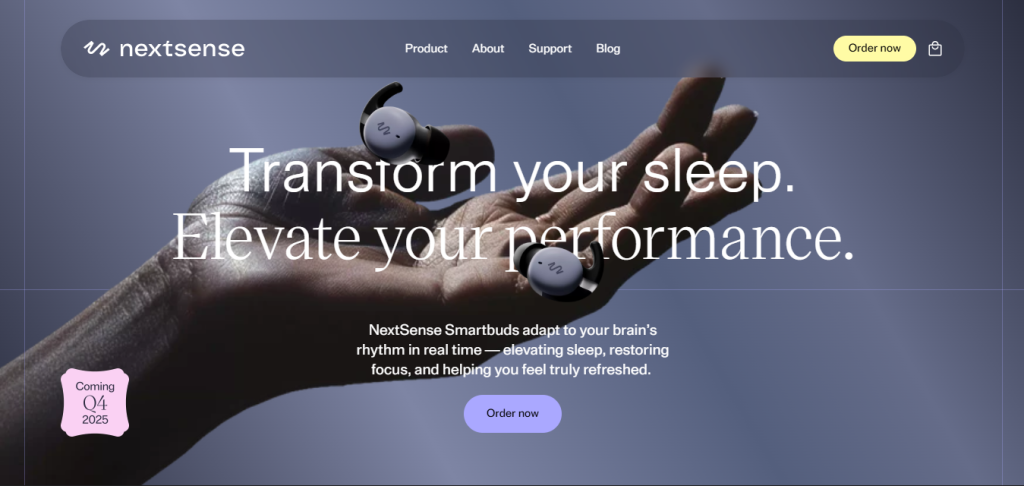
NextSense, Inc. has secured $16,000,000 in Series A funding to advance a new frontier in neuroscience: continuous, real-world brain monitoring through wearable sensors. The round includes backing from Ascension Ventures, Satori Neuro, Corundrum Neuroscience Fund, David Eagleman, Esther Dyson, and Bradley Horowitz, signaling deep conviction in NextSense’s mission to build a scalable platform for brain-based data insights outside the lab.
Founded by Jonathan Berent, NextSense develops ear-based biosensing technology capable of capturing neural activity in everyday settings - from sleep to work to physical activity - without requiring clinical equipment. Instead of relying on mismatched snapshots collected during controlled experiments, NextSense enables continuous neural data capture that reflects how the brain behaves in the real world.
The company sits at the convergence of neuroscience, wearables, and personalized health, where data is shifting from reactive diagnostics to proactive cognitive optimization.
The Problem: Neural Data Is Locked Inside Labs
Modern brain research has made extraordinary progress, but it relies on controlled lab environments that fail to reflect how neural patterns shift across daily life. Sleep studies require overnight clinics. EEG tests take place in medical settings. Long-term monitoring is expensive, invasive, and impractical for large populations.
As a result:
- More than 85% of brain-monitoring research data is episodic rather than continuous.
- Neurological conditions often take years to diagnose due to limited longitudinal data.
- And despite billions in neuroscience research, the brain remains the least measured organ in the body.
This gap becomes critical when applied to sleep disorders, mental health conditions, neurodegeneration, and learning science - all areas where changes unfold slowly and context matters.
NextSense’s wearable platform aims to unlock that missing temporal dimension.
The Shift: Brain Technology Moves from Clinical to Consumer
Neuroscience is undergoing the same transformation wearables brought to cardiology and metabolic health. Just as glucose monitors and smartwatches moved biometric tracking from hospitals to homes, neural sensing is poised to transition from clinical trials to everyday life.
Market trends point in the same direction:
- The global neurotech market is forecasted to exceed $50B by 2030.
- Consumer neurodevices are growing at ~17% CAGR.
- Mental and neurological disorders account for over 28% of global health burdens, yet remain data-poor compared to cardiovascular disease.
And as AI systems become more personalized, real-world physiological data becomes a core input - not an afterthought.
The companies that control real-world brain datasets will anchor the next wave of cognitive tech breakthroughs, from mental health therapies to adaptive learning platforms.
The Strategic Advantage: Becoming the Neural Data Infrastructure Layer
What makes NextSense especially compelling is not just its hardware - it’s the platform layer. Brain data is noisy, complex, and difficult to interpret without signal processing expertise. Tools that merely collect brain activity struggle to scale commercially. Tools that standardize, interpret, and integrate neural signals into product ecosystems become infrastructure.
Once a platform becomes the translation layer between raw neural data and actionable insights, switching costs rise dramatically:
- Historical sleep patterns and cognitive baselines are stored within the system.
- AI models improve with longitudinal data that can't be replicated easily.
- Consumer and clinical integrations become dependent on shared signal standards.
This is how an experimental technology turns into an operating platform.
Neurotech companies that win won’t just measure the brain - they’ll define how other companies use that measurement.
Why Now Is the Inflection Point
Three forces are converging simultaneously:
- Sensor miniaturization has reached clinical-grade accuracy without sacrificing mobility.
- AI signaling models now rival traditional EEG labs in classification performance.
- Public demand for brain-health optimization is skyrocketing due to burnout, sleep disorders, and mental health concerns.
Meanwhile, large tech ecosystems - from AR glasses to spatial computing - are investing heavily in neural interfaces. Devices that once measured outward behavior will soon adapt based on internal cognitive states.
NextSense’s platform arrives as the bridge between neuroscience research and everyday applications.
What Comes Next
With fresh Series A capital, NextSense is expected to:
- Expand clinical partnerships and longitudinal research cohorts
- Improve AI models that convert neural signals into actionable states
- Scale hardware manufacturing and consumer-ready deployments
- Integrate data streams into wellness, learning, and clinical platforms
The company’s long-term vision positions the brain as the next major biometric, not for novelty but for continuous cognitive health.
If wearables helped us understand the heart, neurotech will help us understand ourselves.
NextSense is building the infrastructure to make that future real.
Related Articles

Latest Rounds
November 30, 2025 by 
EcoG Raises $18.57M to Accelerate the Operating System for the Global EV Charging Economy
EcoG has raised $18,573,280 in new funding, led by GET Fund with participation from Extantia Capital and Bayern Kapital. Founded...
Read More
Latest Rounds
November 30, 2025 by
Tidalwave Raises $22M Series A to Build the Infrastructure Layer Modern Homebuilders Need for AI-Driven Operations
Tidalwave has raised $22,000,000 in their Series A, led by Permanent Capital with participation from D.R. Horton, Inc. and Engineering...
Read More
Latest Rounds
November 30, 2025 by
WellBeam Raises $10M to Unify Care Coordination Across the Entire Patient Journey
WellBeam Inc. has secured $10 million in Series A funding, marking a major step toward fixing one of the most...
Read More
Latest Rounds
November 30, 2025 by
Automat Raises $15.5M to Redefine Industrial Automation With Adaptive AI
Automat has secured $15.5 million in Series A funding, a major milestone for a company working to radically transform how...
Read More
Latest Rounds
November 30, 2025 by
Poly Raises $8M to Reinvent How People Organize, Search, and Think With Their Files
Poly (US) has closed an $8,000,000 Seed round, marking a decisive moment for one of the most ambitious productivity startups...
Read More
Latest Rounds
November 30, 2025 by
Voio Raises $8.6M to Power AI That Understands Patients as Individuals, Not Data Points
Voio has secured $8.6 million in Seed funding, marking a major step forward for a company working to bring true...
Read More
Latest Rounds
November 30, 2025 by
Ember Raises $4.3M to Reinvent AI-Driven Revenue Cycle Management for Healthcare Providers
Ember has secured $4.3 million in Seed funding, marking a major step toward transforming one of healthcare’s most expensive, error-prone,...
Read More
Latest Rounds
November 30, 2025 by
Modern Life Raises $20M to Redefine Life Insurance Infrastructure With AI-Powered Tools for Advisors
Modern Life has secured $20 million in new funding, marking another major milestone in its mission to rebuild the fractured,...
Read More
Latest Rounds
November 30, 2025 by
Ampersand Raises $80M to Power the Next Era of High-Performance Materials
Ampersand has secured a major $80 million Series A round, positioning itself as one of the most significant deep-tech companies...
Read More
Latest Rounds
November 30, 2025 by
OpenHands Raises $18.8M to Bring Autonomous Coding Agents Into the Enterprise
OpenHands has raised $18.8 million in Series A funding, marking one of the strongest signals yet that autonomous software development...
Read More