
Frugal Raises $5M to Turn Inefficient Code Into Cloud Savings
November 28, 2025
by
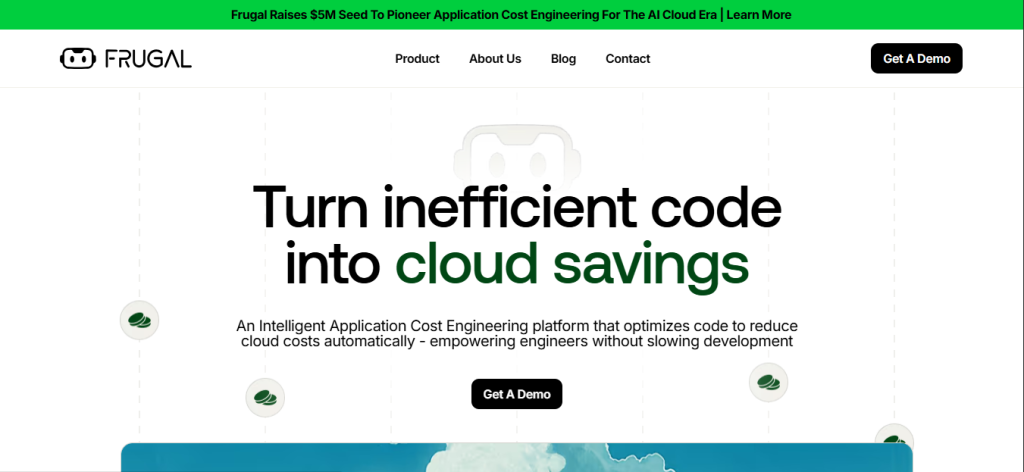
Frugal has raised $5 million in Seed funding, led by Whitecap Venture Partners, with additional backing from Mistral Venture Partners and founders of Snyk and CloudCheckr. The company is tackling one of the biggest hidden drains in cloud infrastructure: application-level inefficiency that silently drives up compute costs.
While most cloud-cost platforms focus on billing dashboards, reserved instances, and usage allocation, Frugal sits deeper in the stack - analyzing code paths and execution behavior to optimize how applications consume cloud resources. Instead of cutting spend by reducing workloads, Frugal cuts spend by making workloads smarter.
With enterprises spending more on cloud than ever, this approach puts Frugal at a critical intersection of DevOps, software engineering, and cloud economics.
Cloud Costs Are Exploding - and Software Is the Culprit
Cloud spend is expected to surpass $1 trillion globally by 2030, driven largely by AI workloads, microservices, and real-time data processing. But the real inefficiency isn’t storage or traffic - it’s code.
Recent estimates show:
- 30–60% of cloud costs come from inefficient application logic, not necessary compute
- Over 70% of engineering teams lack tooling that connects performance issues to cloud billing
- Companies overspend an average of $12M annually on under-optimized compute workloads at enterprise scale
Most optimization tools sit at the infrastructure level - autoscaling, containers, instance sizing, usage reports - but they stop short of telling engineers which code decisions are costing millions.
Frugal bridges that gap.
How Frugal’s Platform Works
Rather than optimizing infrastructure settings, Frugal analyzes how code consumes cloud resources under real execution. That means inspecting concurrency, memory allocations, API sequences, network hops, and compute-heavy logic - connecting these events to specific dollar outcomes.
The platform identifies sources of waste such as unnecessary batch jobs, unbounded parallelism, redundant microservice calls, or inefficient loops that drive compute spikes.
The core promise: make workloads cheaper by making them more efficient - not smaller.
This allows companies to continue scaling features and traffic without encountering runaway infrastructure bills.
Where the Real Advantage Lies: Owning the Cost-Performance Feedback Loop
Here’s where the strategic leverage emerges for both Frugal and founders watching cloud-native markets:
Whoever controls the feedback loop between code decisions and financial outcomes will shape how modern applications are built.
Today, engineers write code with incomplete visibility. They see performance metrics and error logs, but rarely see financial impact per line, per endpoint, or per deployment. That disconnect forces companies to optimize reactively - usually after a CFO demands budget cuts.
Platforms like Frugal flip decision-making from cost correction to cost-aware development.
Once cost metrics become part of the development process itself:
- Architectural decisions become tied to financial outcomes
- Teams can forecast spend before deployments
- Scalability planning becomes strategic, not reactive
- Engineering, finance, and DevOps align around the same metrics
This mirrors what happened when Datadog made observability a default, or when Snyk shifted security earlier into development. The category winner isn’t just a tool - it becomes the expected workflow.
Frugal is positioning itself to be that workflow for cloud cost intelligence.
Why Investors Are Moving Now
Cloud cost optimization is no longer a niche concern - it’s a board-level problem:
- AI compute alone is doubling cloud spend every 6–9 months
- Kubernetes-based architectures create 20–40% idle compute waste
- FinOps adoption has grown over 100% in the past three years
Despite billions spent on cloud-cost tools, most solutions focus on dashboards, not engineering action.
The market is maturing in three phases:
- Visibility – show where costs live
- Optimization – automate small savings
- Design-level efficiency – change the software itself
Frugal lands squarely in phase three - where long-term savings are measured in millions, not percentages.
What’s Next for Frugal
With new funding, Frugal is expected to expand:
- Support for AWS, Azure, GCP, and Snowflake across environments
- Cost-projection engines integrated into CI/CD workflows
- Optimization specifically designed for AI inference pipelines
- Partnerships across APM and internal developer platforms
- Hiring in distributed systems engineering, cost modeling, and growth
The outcome isn't just reduced spend - it’s a structural shift where software is designed to scale responsibly from day one.
Companies that treat cost as architectural strategy will outperform those that treat it as budgeting cleanup.
Related Articles

Latest Rounds
November 30, 2025 by 
EcoG Raises $18.57M to Accelerate the Operating System for the Global EV Charging Economy
EcoG has raised $18,573,280 in new funding, led by GET Fund with participation from Extantia Capital and Bayern Kapital. Founded...
Read More
Latest Rounds
November 30, 2025 by
Tidalwave Raises $22M Series A to Build the Infrastructure Layer Modern Homebuilders Need for AI-Driven Operations
Tidalwave has raised $22,000,000 in their Series A, led by Permanent Capital with participation from D.R. Horton, Inc. and Engineering...
Read More
Latest Rounds
November 30, 2025 by
WellBeam Raises $10M to Unify Care Coordination Across the Entire Patient Journey
WellBeam Inc. has secured $10 million in Series A funding, marking a major step toward fixing one of the most...
Read More
Latest Rounds
November 30, 2025 by
Automat Raises $15.5M to Redefine Industrial Automation With Adaptive AI
Automat has secured $15.5 million in Series A funding, a major milestone for a company working to radically transform how...
Read More
Latest Rounds
November 30, 2025 by
Poly Raises $8M to Reinvent How People Organize, Search, and Think With Their Files
Poly (US) has closed an $8,000,000 Seed round, marking a decisive moment for one of the most ambitious productivity startups...
Read More
Latest Rounds
November 30, 2025 by
Voio Raises $8.6M to Power AI That Understands Patients as Individuals, Not Data Points
Voio has secured $8.6 million in Seed funding, marking a major step forward for a company working to bring true...
Read More
Latest Rounds
November 30, 2025 by
Ember Raises $4.3M to Reinvent AI-Driven Revenue Cycle Management for Healthcare Providers
Ember has secured $4.3 million in Seed funding, marking a major step toward transforming one of healthcare’s most expensive, error-prone,...
Read More
Latest Rounds
November 30, 2025 by
Modern Life Raises $20M to Redefine Life Insurance Infrastructure With AI-Powered Tools for Advisors
Modern Life has secured $20 million in new funding, marking another major milestone in its mission to rebuild the fractured,...
Read More
Latest Rounds
November 30, 2025 by
Ampersand Raises $80M to Power the Next Era of High-Performance Materials
Ampersand has secured a major $80 million Series A round, positioning itself as one of the most significant deep-tech companies...
Read More
Latest Rounds
November 30, 2025 by
OpenHands Raises $18.8M to Bring Autonomous Coding Agents Into the Enterprise
OpenHands has raised $18.8 million in Series A funding, marking one of the strongest signals yet that autonomous software development...
Read More