
NcodIN Raises $18.4M to Build the Next Generation of Photonic Chips for AI and High-Performance Computing
November 30, 2025
by
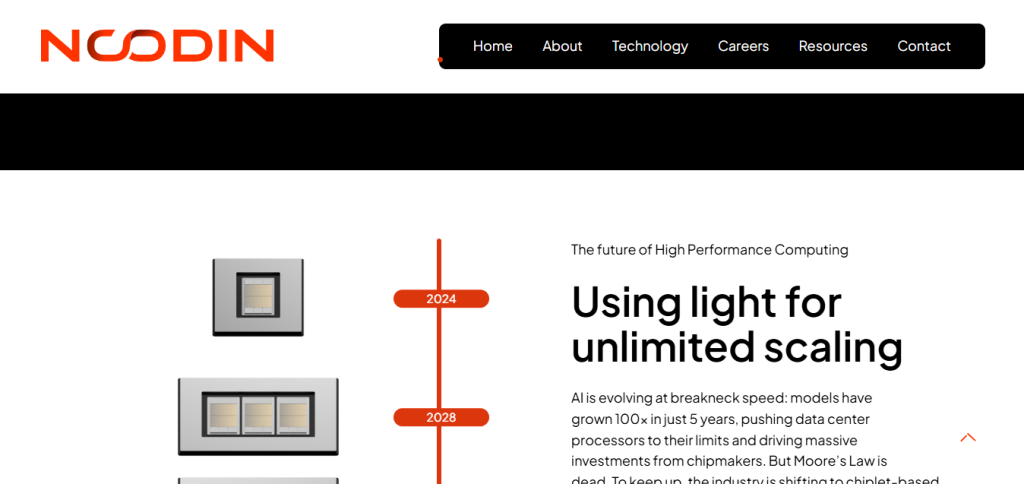
NcodIN has raised $18,456,480 in Seed funding, marking one of the most notable early-stage rounds in the photonics and semiconductor space this year. Led by MIG Capital, with participation from Maverick Silicon, PhotonVentures, Verve Ventures, Elaia, Earlybird Venture Capital, and OVNI, the raise underscores one message coming from the deep-tech investment world: compute is hitting a wall, and photonics may be the only way through it.
Founded by Francesco Manegatti, PhD, NcodIN is developing integrated photonic chips engineered for the growing demands of AI training, inference, and intensive high-performance computing. GPUs are becoming harder to scale, harder to cool, and increasingly expensive to power. The world’s compute appetite is rising faster than semiconductor physics can accommodate - and NcodIN is betting on light, not electricity, to unlock the next leap forward.
A Global Compute Bottleneck Is Already Here
Modern AI models are doubling in size roughly every 5–10 months, and global AI compute demand is projected to grow 10× by 2030. Yet electrical interconnects - the copper paths used in traditional chips - are already operating at their physical limits. Data centers are straining too: AI-focused facilities consumed around 4–5% of U.S. electricity in 2023, and that number is expected to double by 2026.
At the same time, 70%+ of AI startups in 2023–2024 reported GPU shortages that slowed model development or customer onboarding. Demand for compute is rising far faster than the industry’s ability to supply it.
This is why the photonic integrated circuit market is projected to exceed $8–9 billion by 2030, accelerating at ~25% CAGR. Investors see where the trend is heading - and so do the companies struggling to access the compute they need.
What NcodIN Is Building
NcodIN is designing photonic chips that use light instead of electrical signals to transfer and process information. The benefits are significant:
- Faster data transfer
- Lower power consumption
- High bandwidth
- Minimal heat generation
This makes photonic chips ideal for AI clusters, robotics, autonomous systems, and cloud infrastructure - any environment where throughput and energy efficiency determine performance.
But what makes NcodIN especially promising is manufacturability. Many photonics breakthroughs remain stuck in research labs because they can’t scale. NcodIN’s core focus is bridging that gap by developing architectures that can actually be produced, packaged, and integrated into real-world compute systems.
The Shift Happening Beneath the Industry
As more companies hit scaling ceilings, the industry is quietly undergoing a strategic pivot. Cloud providers and AI labs are no longer asking, “How do we buy more GPUs?” They’re asking, “How do we redesign the entire compute stack?”
This is where photonics gains massive leverage.
When a technology begins solving constraints that can’t be solved any other way, it becomes more than an upgrade - it becomes foundational. And once a new compute layer becomes foundational, it gains something far more valuable than user adoption: institutional dependence.
Founders rarely talk about this, but it’s one of the most powerful dynamics in deep-tech. When your solution becomes the system others rely on, switching becomes virtually impossible. Over time, performance advantages compound, integrations deepen, and your technology evolves into part of the industry’s backbone. Companies that can reshape an underlying layer of infrastructure often end up defining the rules for everyone else.
NcodIN is building toward that position - not as a component provider, but as a compute enabler whose technology becomes the baseline expectation for future AI performance.
AI Demand Is Reshaping Every Layer of Hardware
In 2024 alone, global AI infrastructure spending surpassed $150 billion, and analysts predict it could reach $500 billion by 2030. Three forces are driving this acceleration:
- Model sizes are exploding
- Enterprises are moving from pilot AI tools to full deployment
- Governments are racing to build sovereign compute capacity
This is why infrastructure startups - especially those tackling power, speed, and throughput limits - are attracting large early-stage rounds. Whoever solves the efficiency bottleneck becomes essential to the entire AI ecosystem.
NcodIN’s photonic platform directly targets these pressure points. With lower heat, lower energy requirements, and faster data throughput, photonics isn’t just a performance boost - it’s an economic advantage for every organization fighting rising data center costs.
What This Funding Unlocks
The $18.4M raise enables NcodIN to accelerate:
- Photonic chip fabrication and testing
- Integration with existing compute workflows
- Expansion of engineering and photonics R&D
- Manufacturing partnerships to prepare for commercial scale
The company will also work with early enterprise and cloud partners to benchmark real-world performance gains - a critical step in becoming an industry standard.
Why NcodIN Is Well-Positioned
Few startups sit at the intersection of three converging forces:
- A global GPU shortage
- A data center power crisis
- Exponential AI growth
This convergence pushes the industry toward alternatives that can scale without burning exponentially more electricity. NcodIN’s timing, technology focus, and investor network position the company to become a long-term infrastructure provider rather than a single-feature hardware vendor.
What Comes Next
The company is entering a pivotal chapter. As AI continues to consume more power and exceed hardware limits, the winners will be the companies that build the compute foundations shaping the next decade.
NcodIN aims to be one of them - using light to overcome the limits of electricity, and building the technology backbone the AI era will rely on.
Related Articles

Latest Rounds
November 30, 2025 by 
EcoG Raises $18.57M to Accelerate the Operating System for the Global EV Charging Economy
EcoG has raised $18,573,280 in new funding, led by GET Fund with participation from Extantia Capital and Bayern Kapital. Founded...
Read More
Latest Rounds
November 30, 2025 by
Tidalwave Raises $22M Series A to Build the Infrastructure Layer Modern Homebuilders Need for AI-Driven Operations
Tidalwave has raised $22,000,000 in their Series A, led by Permanent Capital with participation from D.R. Horton, Inc. and Engineering...
Read More
Latest Rounds
November 30, 2025 by
WellBeam Raises $10M to Unify Care Coordination Across the Entire Patient Journey
WellBeam Inc. has secured $10 million in Series A funding, marking a major step toward fixing one of the most...
Read More
Latest Rounds
November 30, 2025 by
Automat Raises $15.5M to Redefine Industrial Automation With Adaptive AI
Automat has secured $15.5 million in Series A funding, a major milestone for a company working to radically transform how...
Read More
Latest Rounds
November 30, 2025 by
Poly Raises $8M to Reinvent How People Organize, Search, and Think With Their Files
Poly (US) has closed an $8,000,000 Seed round, marking a decisive moment for one of the most ambitious productivity startups...
Read More
Latest Rounds
November 30, 2025 by
Voio Raises $8.6M to Power AI That Understands Patients as Individuals, Not Data Points
Voio has secured $8.6 million in Seed funding, marking a major step forward for a company working to bring true...
Read More
Latest Rounds
November 30, 2025 by
Ember Raises $4.3M to Reinvent AI-Driven Revenue Cycle Management for Healthcare Providers
Ember has secured $4.3 million in Seed funding, marking a major step toward transforming one of healthcare’s most expensive, error-prone,...
Read More
Latest Rounds
November 30, 2025 by
Modern Life Raises $20M to Redefine Life Insurance Infrastructure With AI-Powered Tools for Advisors
Modern Life has secured $20 million in new funding, marking another major milestone in its mission to rebuild the fractured,...
Read More
Latest Rounds
November 30, 2025 by
Ampersand Raises $80M to Power the Next Era of High-Performance Materials
Ampersand has secured a major $80 million Series A round, positioning itself as one of the most significant deep-tech companies...
Read More
Latest Rounds
November 30, 2025 by
OpenHands Raises $18.8M to Bring Autonomous Coding Agents Into the Enterprise
OpenHands has raised $18.8 million in Series A funding, marking one of the strongest signals yet that autonomous software development...
Read More