
Cephia AI Raises $4 Million Seed Round to Build the Visual AI Foundation for Manufacturing, Robotics, and Optical Systems
November 7, 2025
by
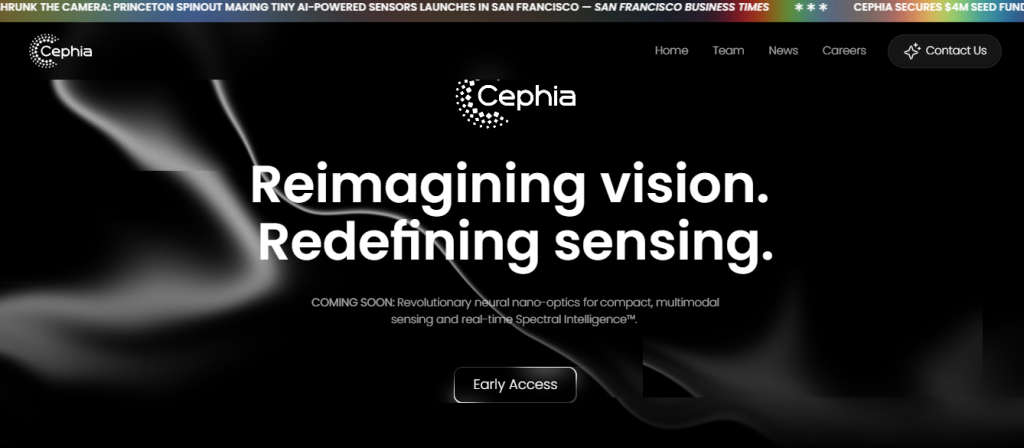
Cephia AI has raised $4,000,000 in their Seed Round, backed by Radiant Opto-Electronics Corporation (ROE), Incharge Capital Partners, MetaVC Partners, NRM Partners, SOSV, and others. Founded by Bo Dong, Felix Heide, and Ethan Tseng, Cephia AI is building a new category of visual intelligence - one that can see, understand, and make decisions across robotics, optical systems, and advanced manufacturing environments. Today’s computer vision models struggle with dynamic lighting, reflections, transparency, distortions, and the complexity of real-world production floors. Cephia’s visual foundation model solves that. Instead of treating images like flat pixels, Cephia reconstructs the true physical-world properties of what the camera sees, enabling AI systems to detect defects, classify materials, and make precision decisions in environments where accuracy is non-negotiable. Cephia isn’t just improving computer vision. It’s redefining how machines perceive reality.
Reframing AI Vision: Not "Recognize an Image" - but "Interpret the Physical World"
Traditional computer vision works like this: feed an image into a neural network, get a classification, hope it works. The problem? Reality doesn’t cooperate. Lighting shifts. Materials reflect. Manufacturing components overlap. Robotics deals with movement, shadows, and transparent surfaces - scenarios where legacy vision models fail. Cephia AI approaches visual perception differently. Using physics-aware AI and computational imaging, the platform generates a deeper understanding of why something looks the way it does. Instead of estimating, Cephia reconstructs - surface geometry, reflective behavior, depth, structure, and material identity. Robots don’t just see an object; they understand its physical properties. AI moves from perception to interpretation.
Infrastructure Over Feature: Cephia Becomes the Vision Operating Layer for Industrial AI
Most companies selling "computer vision" today are app developers wrapping LLMs around camera feeds. Cephia is building infrastructure - a visual perception layer that robotics, manufacturing equipment, and optical systems can plug into. The platform ingests raw visual data, enhances it, interprets 3D material structures, and pushes real-time signals back to machines. Every step of the chain - capture, perception, reasoning, decision - lives in one model. Instead of forcing enterprises to stitch together dozens of disconnected vision tools, Cephia becomes the single point of truth for how machines see their environment. When the perception layer becomes standardized, every automation layer above it becomes easier to build. Vision stops being a blocker and becomes a multiplier.
The Companies That Win Aren’t the Ones Using AI - They're the Ones Controlling the Foundation Layer
Here’s the insight founders will find valuable. Big industries - manufacturing, robotics, automotive - don’t change when a new app launches. They change when the foundation layer shifts. LLM companies control text. GPU companies control compute. Cephia wants to control machine perception. Instead of fighting for visibility at the application layer, Cephia sits deeper in the stack - where the value compounds and dependency becomes standard. When you become the default perception layer for robotics, factories, automotive optical calibration, or augmented reality systems, no one replaces you. Category kings don’t compete for users - they become the dependency others build on top of.
Investor Alignment: They’re Not Betting on a Vision App - They’re Betting on the Future of Machine Perception
Radiant Opto-Electronics (ROE), MetaVC Partners, and SOSV understand how hardware and optics scale. These investors aren’t interested in short-term AI hype. They’re backing the perception infrastructure required to power:
- precision manufacturing
- autonomous robotic decision-making
- optical calibration systems
- AR/VR spatial perception
- industrial inspection automation
The pattern is obvious:
When machines can see accurately, entire industries upgrade.
Investors are betting on the foundational layer that enables automation at global scale.
A Market Poised for Disruption: The World Is Designed Around Machines That Can’t Actually ‘See’
Computer vision adoption is exploding - but failing in execution. Here’s the current landscape:
- 45% of vision AI initiatives fail before deployment due to environmental complexity (lighting, reflections, movement).
- In manufacturing, mis-detection rates in quality inspection result in $2.6 trillion in annual waste globally.
- Robotics companies spend 30%+ of engineering budget compensating for bad camera perception.
- The vision AI market is projected to exceed $55 billion by 2030, fueled by automation and autonomous systems.
Enter Cephia:
Instead of patching vision failures, they remove the failure point from the system.
The market doesn’t just need “better vision models.”
It needs correct perception models.
Why Cephia Wins: Precision Beats Probability
Legacy computer vision relies on probability. Cephia relies on physics. Instead of guessing what an object is, Cephia determines what it *must be *based on its optical properties and spatial structure. That means:
- Fewer false positives
- Instant defect detection
- Real-time adaptation in changing environments
- Higher confidence decisions for autonomous systems
Manufacturing doesn’t reward approximations.
Robotics doesn’t reward “maybe.”
AR/VR doesn’t reward pixel confusion.
Cephia gives machines the one thing AI historically lacked: certainty.
What’s Next for Cephia AI
With $4M in funding, Cephia is scaling engineering, expanding industrial partnerships, and building integrations with robotics OEMs and advanced manufacturers. The company’s roadmap includes:
- deeper multimodal visual reasoning (visual + geometric + contextual)
- increasing model generalization across different lighting and surfaces
- enabling global deployment of machine perception modules across factories
The long-term vision is bold but simple:
Cephia becomes the visual foundation model for the physical world, the same way LLMs became the language model for the digital world.
Cephia isn’t improving vision AI.
It’s standardizing how machines understand reality.
Final Thoughts
Most AI companies talk about “seeing.”
Cephia talks about understanding.
Most companies optimize perception.
Cephia optimizes truth.
Today’s automation struggles because machines interpret visual input like humans interpret blurry photos - with uncertainty. Cephia gives machines perception the way humans experience touch: grounded in physical reality, not probability.
Cephia isn’t here to improve how machines see the world.
It’s here to teach machines what the world actually is.
Related Articles

Latest Rounds
November 30, 2025 by
EcoG Raises $18.57M to Accelerate the Operating System for the Global EV Charging Economy
EcoG has raised $18,573,280 in new funding, led by GET Fund with participation from Extantia Capital and Bayern Kapital. Founded...
Read More
Latest Rounds
November 30, 2025 by
Tidalwave Raises $22M Series A to Build the Infrastructure Layer Modern Homebuilders Need for AI-Driven Operations
Tidalwave has raised $22,000,000 in their Series A, led by Permanent Capital with participation from D.R. Horton, Inc. and Engineering...
Read More
Latest Rounds
November 30, 2025 by 
WellBeam Raises $10M to Unify Care Coordination Across the Entire Patient Journey
WellBeam Inc. has secured $10 million in Series A funding, marking a major step toward fixing one of the most...
Read More
Latest Rounds
November 30, 2025 by
Automat Raises $15.5M to Redefine Industrial Automation With Adaptive AI
Automat has secured $15.5 million in Series A funding, a major milestone for a company working to radically transform how...
Read More
Latest Rounds
November 30, 2025 by
Poly Raises $8M to Reinvent How People Organize, Search, and Think With Their Files
Poly (US) has closed an $8,000,000 Seed round, marking a decisive moment for one of the most ambitious productivity startups...
Read More
Latest Rounds
November 30, 2025 by
Voio Raises $8.6M to Power AI That Understands Patients as Individuals, Not Data Points
Voio has secured $8.6 million in Seed funding, marking a major step forward for a company working to bring true...
Read More
Latest Rounds
November 30, 2025 by
Ember Raises $4.3M to Reinvent AI-Driven Revenue Cycle Management for Healthcare Providers
Ember has secured $4.3 million in Seed funding, marking a major step toward transforming one of healthcare’s most expensive, error-prone,...
Read More
Latest Rounds
November 30, 2025 by
Modern Life Raises $20M to Redefine Life Insurance Infrastructure With AI-Powered Tools for Advisors
Modern Life has secured $20 million in new funding, marking another major milestone in its mission to rebuild the fractured,...
Read More
Latest Rounds
November 30, 2025 by
Ampersand Raises $80M to Power the Next Era of High-Performance Materials
Ampersand has secured a major $80 million Series A round, positioning itself as one of the most significant deep-tech companies...
Read More
Latest Rounds
November 30, 2025 by
OpenHands Raises $18.8M to Bring Autonomous Coding Agents Into the Enterprise
OpenHands has raised $18.8 million in Series A funding, marking one of the strongest signals yet that autonomous software development...
Read More