
Revenium Raises $13.5M to Show Companies What Every AI Decision Really Costs
November 30, 2025
by
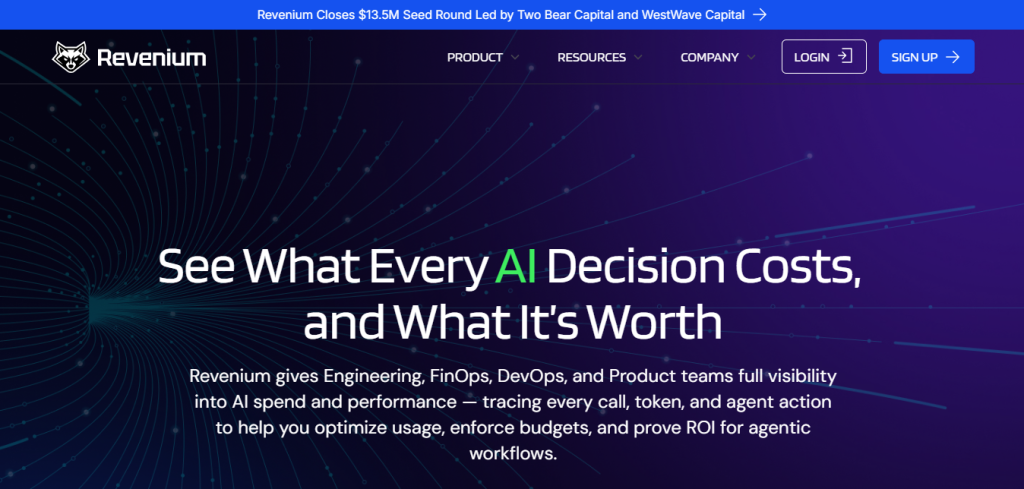
Revenium has raised $13.5 million in Seed funding, a major step forward for a platform built to solve one of the biggest blind spots in modern enterprise AI: cost transparency. Backed by Two Bear Capital and WestWave Capital, the company is creating a real-time economic engine that helps engineering, DevOps, FinOps, and product teams finally understand the financial impact of every AI workload, API call, and model decision.
Founded by John Rowell, Revenium sits at the intersection of AI adoption and fiscal accountability - two forces that are rapidly colliding as organizations push more critical systems into machine-driven decisioning. For years, businesses have been pouring money into AI-powered products without a clear picture of how those decisions convert to real infrastructure costs or measurable returns. Revenium aims to change that.
The Hidden Cost Crisis Inside AI Adoption
As companies scale AI, costs are becoming unpredictable. A single model deployment, feature rollout, or prompt-heavy workflow can rack up cloud expenses before teams even realize what happened. This is not a fringe issue; research shows:
- AI infrastructure costs have risen an estimated 30–50% year-over-year for mid-market companies.
- 67% of enterprises say model experimentation is their fastest-growing cloud expense.
- Companies may be losing up to 20% of AI budget annually due to uninformed or uncontrolled model usage.
The challenge isn’t just cost - it’s clarity. Businesses have no way to see what each AI decision costs per user, per session, or per product feature.
Revenium fills that gap with a platform built to measure:
- The cost of every AI request
- The ROI of every AI output
- The financial efficiency of entire workflows
From LLM-based customer support to automated underwriting, teams get real-time visibility into how AI is affecting margins.
It’s here where a deeper insight becomes clear: AI will not scale sustainably without economic visibility baked into the architecture from day one. This is the shift founders need to pay attention to. The first wave of AI startups focused on capability - "what models can do." The next wave will be defined by AI profitability - "what models are worth." Companies that understand the unit economics of AI will outpace those that treat compute as an afterthought. And over time, this gap becomes exponential. AI becomes cheaper, faster, and more precise for companies who treat cost intelligence as infrastructure - not a finance report.
Why Enterprises Are Prioritizing AI Cost Transparency
The shift is already happening across the industry:
- FinOps adoption is expected to grow 25% annually through 2031.
- Companies that implement AI cost governance frameworks report up to 40% reduction in model spend.
- With the launch of heavier multimodal models, cloud inference costs are projected to increase 3–5x over the next five years.
AI is no longer a “test-and-learn expense.” It’s now a core part of product strategy - and for many companies, a major cost center.
Revenium helps organizations track not just the cost of running AI but also the value each model is delivering:
- Did a new model increase retention?
- Did response quality reduce support ticket load?
- Did faster inference speed improve conversion rates?
- Are multiple models doing duplicative work?
This blend of technical and financial insight is what investors see as the next essential layer of AI infrastructure.
The Platform That Turns AI Usage Into Actionable Intelligence
Revenium integrates directly with existing AI pipelines and cloud platforms, giving teams immediate visibility without major workflow changes.
Key capabilities include:
- Real-time AI cost analysis
- Usage forecasting and anomaly detection
- ROI dashboards for product teams
- Multi-cloud and multi-model support
- Policy-based cost controls
This eliminates guesswork and empowers companies to scale AI usage responsibly - and profitably.
For product leaders, it becomes easier to justify AI feature expansions.
For finance teams, it creates predictable cost models.
For engineering teams, it exposes inefficiencies before they become incidents.
And for executives, it offers the one thing missing from most AI roadmaps: clarity.
Why Revenium Is Poised for Rapid Growth
Markets move in waves, and right now, the AI infrastructure wave is entering its next phase: optimization. Companies have experimented. They’ve deployed. Now they need to refine.
Revenium is entering at precisely the right moment.
Key tailwinds include:
- Surging AI adoption across enterprise SaaS
- Rising cloud costs driven by intensive inference loads
- Increased demand for model governance and transparency
- Growing compliance pressure to document AI decisions and data flows
As organizations move into multi-model and hybrid AI stacks, visibility becomes even more critical. Revenium’s architecture is built to support that complexity.
What’s Next for Revenium
With fresh funding, the company plans to:
- Expand engineering and data science teams
- Build deeper integrations with cloud and model providers
- Enhance predictive cost modeling features
- Develop advanced financial governance tools for enterprise AI teams
- Grow sales and partnerships targeting mid-market and enterprise clients
Revenium is positioning itself as the financial intelligence layer for modern AI systems - the part that turns experimentation into sustainable, scalable operations.
As AI becomes core infrastructure across industries, companies won’t just need faster models.
They’ll need smarter visibility.
Revenium is building exactly that.
Related Articles

Latest Rounds
November 30, 2025 by 
EcoG Raises $18.57M to Accelerate the Operating System for the Global EV Charging Economy
EcoG has raised $18,573,280 in new funding, led by GET Fund with participation from Extantia Capital and Bayern Kapital. Founded...
Read More
Latest Rounds
November 30, 2025 by
Tidalwave Raises $22M Series A to Build the Infrastructure Layer Modern Homebuilders Need for AI-Driven Operations
Tidalwave has raised $22,000,000 in their Series A, led by Permanent Capital with participation from D.R. Horton, Inc. and Engineering...
Read More
Latest Rounds
November 30, 2025 by
WellBeam Raises $10M to Unify Care Coordination Across the Entire Patient Journey
WellBeam Inc. has secured $10 million in Series A funding, marking a major step toward fixing one of the most...
Read More
Latest Rounds
November 30, 2025 by
Automat Raises $15.5M to Redefine Industrial Automation With Adaptive AI
Automat has secured $15.5 million in Series A funding, a major milestone for a company working to radically transform how...
Read More
Latest Rounds
November 30, 2025 by
Poly Raises $8M to Reinvent How People Organize, Search, and Think With Their Files
Poly (US) has closed an $8,000,000 Seed round, marking a decisive moment for one of the most ambitious productivity startups...
Read More
Latest Rounds
November 30, 2025 by
Voio Raises $8.6M to Power AI That Understands Patients as Individuals, Not Data Points
Voio has secured $8.6 million in Seed funding, marking a major step forward for a company working to bring true...
Read More
Latest Rounds
November 30, 2025 by
Ember Raises $4.3M to Reinvent AI-Driven Revenue Cycle Management for Healthcare Providers
Ember has secured $4.3 million in Seed funding, marking a major step toward transforming one of healthcare’s most expensive, error-prone,...
Read More
Latest Rounds
November 30, 2025 by
Modern Life Raises $20M to Redefine Life Insurance Infrastructure With AI-Powered Tools for Advisors
Modern Life has secured $20 million in new funding, marking another major milestone in its mission to rebuild the fractured,...
Read More
Latest Rounds
November 30, 2025 by
Ampersand Raises $80M to Power the Next Era of High-Performance Materials
Ampersand has secured a major $80 million Series A round, positioning itself as one of the most significant deep-tech companies...
Read More
Latest Rounds
November 30, 2025 by
OpenHands Raises $18.8M to Bring Autonomous Coding Agents Into the Enterprise
OpenHands has raised $18.8 million in Series A funding, marking one of the strongest signals yet that autonomous software development...
Read More