
Runlayer Raises $11M Seed Round to Become the Enterprise Security Backbone for AI Deployments
November 26, 2025
by
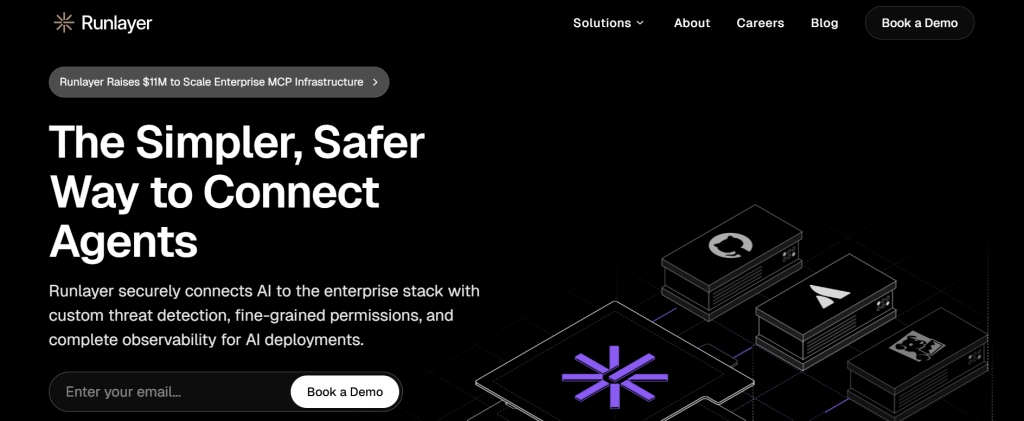
Runlayer has raised $11,000,000 in their Seed Round, marking a major step toward solving one of the most urgent bottlenecks in enterprise AI adoption: secure, controlled, observable connections between AI systems and sensitive internal data. Founded by Andrew Berman, a builder known for combining frontier technology with real-world usability, Runlayer is redefining what safe AI enablement looks like in large organizations. As enterprises accelerate AI pilots, scale agentic workflows, and embed models into critical internal processes, security teams are facing an entirely new attack surface. Runlayer enters the market with a clear mission - to provide the secure connective tissue that allows AI to operate inside the enterprise without exposing the organization to unacceptable risk.
The Problem: Enterprises Want AI, but Their Security Stack Isn’t Built for It
Companies today are experimenting with multimodal models, agentic reasoning, retrieval systems, and model orchestration layers. But integrating these models with real production data introduces unprecedented risks. Every model call could leak sensitive information. Every agentic workflow creates new pathways for escalation. Every dataset connected to a model becomes a potential breach vector. Enterprises are quickly learning that successful AI implementation requires much more than model performance - it requires a robust security architecture around the model itself. Runlayer solves this by giving enterprises a way to control how AI interacts with internal systems through fine-grained permissions, custom threat detection, and deep observability across every AI action. It transforms experimental AI into something that can actually be deployed inside regulated and high-stakes environments.
A New Security Category: The Enterprise AI Connectivity Layer
Runlayer isn’t a monitoring tool, a wrapper, or a firewall. It’s an enterprise AI security layer, designed to sit between AI systems and the company’s internal apps, data sources, and operational stack. The platform provides granular permissioning around what AI can access, what it can modify, and what it can request - mirroring the concept of least privilege, but built specifically for model-driven workflows. By embedding visibility into every inference request, every transformation, and every system interaction, Runlayer offers the control enterprises need to scale AI confidently. This architectural position is emerging as one of the must-have layers in the modern enterprise AI stack. And because AI adoption is happening faster than companies can adapt their existing security tooling, the demand for this category is accelerating.
A Founder Who Understands the Gap Between Cutting-Edge AI and Real-World Systems
Andrew Berman brings an unusual combination of experience: he’s both a deep builder and a seasoned investor. Having created Nanit, the first camera to track human behavior, Berman has a track record of applying novel technology to real, highly practical use cases that touch consumers at scale. His career as a founder, investor, and advisor gives Runlayer a unique advantage: the ability to understand not only how to build advanced products, but how to place them correctly inside enterprise structures where technical, operational, financial, and compliance considerations all collide. That blend is rare - and in a space as complex as enterprise AI security, it matters.
Enterprises Don’t Fail at AI Because of Models - They Fail Because of Access Controls
AI adoption doesn’t stall due to lack of model performance - models are already good enough. Adoption stalls because companies don’t know how to safely give these models controlled access to internal systems.
This is the missing link that security leaders, CIOs, and AI teams are running into repeatedly. Models are powerful, but that power becomes dangerous when connected to sensitive databases, operational systems, or internal APIs. Giving models access feels like handing a brilliant but unpredictable intern the master key to the organization. Runlayer solves the hardest part of enterprise AI rollout - defining, enforcing, and monitoring the exact boundaries where models can operate safely. When that boundary becomes programmable and observable, enterprises unlock scale without increasing exposure. It’s this insight - recognizing that access control, not model ability, is the true bottleneck - that positions Runlayer at the center of the next wave of enterprise AI maturity.
Investor Signal: Backed by Leading Enterprise AI and Security-Focused Funds
While the company has not released its full investor list publicly, the profile of participating investors points toward a thesis anchored in enterprise security, infrastructure reliability, and scalable AI enablement. These backers understand that the future of enterprise AI won’t be defined by individual models but by the systems that connect models safely to mission-critical environments. Their investment reflects a belief that the enterprise AI security layer will be as essential as identity management, cloud security, and access governance in the coming decade.
A Market Moving Fast - and Breaking Faster Without Security Layers Like Runlayer
The enterprise AI sector is experiencing explosive growth:
- 80% of enterprises plan to integrate AI deeply into internal systems within the next 24 months.
- AI-driven workloads in enterprise environments are projected to grow 600% by 2030.
- 70% of security leaders say AI introduces “new, unfamiliar, and unmonitored” attack surfaces.
- Enterprise AI security spending is expected to exceed $20B annually by 2030.
Companies are running ahead with model adoption, but their existing security stack is not built for AI-driven interactions. This creates an asymmetry - AI is growing faster than the controls designed to govern it. Runlayer sits directly in this gap. As enterprises deploy increasingly autonomous AI systems, the need for a secure, observable, permissioned AI-connectivity infrastructure becomes unavoidable. The category Runlayer is building into is not optional; it’s where AI meets real-world risk.
Why Runlayer Is Positioned to Lead This New Category
Runlayer wins because it recognizes the emerging reality of enterprise AI: security cannot be an afterthought. The systems enterprises rely on to enforce identity, governance, auditability, and permissions were not designed for autonomous reasoning systems making real-time decisions. Runlayer introduces the missing layer - a programmable security boundary around AI behavior. It enables enterprises to adopt AI without losing control, visibility, or safety. As AI systems become operational rather than experimental, this layer becomes foundational. Runlayer is building the infrastructure that makes enterprise AI actually deployable.
Final Thoughts
Runlayer arrives at the exact moment when enterprises are hitting the limits of what their existing infrastructure can support. AI is powerful, but no company can safely plug models into internal systems without protective architecture. Runlayer gives enterprises the ability to turn AI from a risky experiment into a secure operational advantage. With $11M in Seed funding, a founder who deeply understands the intersection of innovation and execution, and a rapidly expanding market need, Runlayer is positioned to become the default security layer for enterprise AI deployments.
Related Articles

Latest Rounds
November 30, 2025 by
EcoG Raises $18.57M to Accelerate the Operating System for the Global EV Charging Economy
EcoG has raised $18,573,280 in new funding, led by GET Fund with participation from Extantia Capital and Bayern Kapital. Founded...
Read More
Latest Rounds
November 30, 2025 by
Tidalwave Raises $22M Series A to Build the Infrastructure Layer Modern Homebuilders Need for AI-Driven Operations
Tidalwave has raised $22,000,000 in their Series A, led by Permanent Capital with participation from D.R. Horton, Inc. and Engineering...
Read More
Latest Rounds
November 30, 2025 by 
WellBeam Raises $10M to Unify Care Coordination Across the Entire Patient Journey
WellBeam Inc. has secured $10 million in Series A funding, marking a major step toward fixing one of the most...
Read More
Latest Rounds
November 30, 2025 by
Automat Raises $15.5M to Redefine Industrial Automation With Adaptive AI
Automat has secured $15.5 million in Series A funding, a major milestone for a company working to radically transform how...
Read More
Latest Rounds
November 30, 2025 by
Poly Raises $8M to Reinvent How People Organize, Search, and Think With Their Files
Poly (US) has closed an $8,000,000 Seed round, marking a decisive moment for one of the most ambitious productivity startups...
Read More
Latest Rounds
November 30, 2025 by
Voio Raises $8.6M to Power AI That Understands Patients as Individuals, Not Data Points
Voio has secured $8.6 million in Seed funding, marking a major step forward for a company working to bring true...
Read More
Latest Rounds
November 30, 2025 by
Ember Raises $4.3M to Reinvent AI-Driven Revenue Cycle Management for Healthcare Providers
Ember has secured $4.3 million in Seed funding, marking a major step toward transforming one of healthcare’s most expensive, error-prone,...
Read More
Latest Rounds
November 30, 2025 by
Modern Life Raises $20M to Redefine Life Insurance Infrastructure With AI-Powered Tools for Advisors
Modern Life has secured $20 million in new funding, marking another major milestone in its mission to rebuild the fractured,...
Read More
Latest Rounds
November 30, 2025 by
Ampersand Raises $80M to Power the Next Era of High-Performance Materials
Ampersand has secured a major $80 million Series A round, positioning itself as one of the most significant deep-tech companies...
Read More
Latest Rounds
November 30, 2025 by
OpenHands Raises $18.8M to Bring Autonomous Coding Agents Into the Enterprise
OpenHands has raised $18.8 million in Series A funding, marking one of the strongest signals yet that autonomous software development...
Read More